Saturday, September 04, 2010


Tuesday, August 24, 2010
Southern Indiana Open Karate Tournament
My dojo is hosting its first ever karate tournament! As the name implies, it's open to any style, though the majority of competitors will likely be Isshinryu. We just started getting our very first pre-registrations, and it's beginning to feel real. New Albany, IN is in south-central Indiana, just over the river from Louisville, KY. We're a touch over three hours north of Nashville, about 90 minutes south of Indianapolis or 2 hours west of Cincinnati. Anybody who can make it, please let me know - I'd love to meet you.
Information as follows:
Date: Saturday, Sept. 18, 2010
Location: Griffin Street Recreation Center
1140 Griffin St.
New Albany, IN 47150-4872
Tournament Fees:
Pre-registration: $25
Walk-in registration: $35
Specator fee at door: $5 (5 & under free)
Schedule of events:
Check-in/registration: 8:30-9:40 AM
Black Belt Meeting: 9:40 AM
Tournament Bow-In 10:00 AM
Pre-registrations must be received by Sept. 10, 2010
Hosted by TJ Rodeghier
Kentuckiana Isshinryu Karate
(502)554-8552 or (812)285-8951
This is an IWKA National Title tournament, meaning that IWKA members may earn title points - you must provide your IWKA# with your registration. You do not need to be a member of the IWKA to compete.
Divisions will be by rank and age with competition in Kata, Kumite, and Weapons. Team Kata diviions will be created the day of the tournament depending on the age, rank, & number of competitors.
Questions, call TJ Sensei, or email at senseitj@insightbb.com
If you want some registration forms, let me know or e-mail Sensei, and we will get some out to you ASAP.
Information as follows:
Date: Saturday, Sept. 18, 2010
Location: Griffin Street Recreation Center
1140 Griffin St.
New Albany, IN 47150-4872
Tournament Fees:
Pre-registration: $25
Walk-in registration: $35
Specator fee at door: $5 (5 & under free)
Schedule of events:
Check-in/registration: 8:30-9:40 AM
Black Belt Meeting: 9:40 AM
Tournament Bow-In 10:00 AM
Pre-registrations must be received by Sept. 10, 2010
Hosted by TJ Rodeghier
Kentuckiana Isshinryu Karate
(502)554-8552 or (812)285-8951
This is an IWKA National Title tournament, meaning that IWKA members may earn title points - you must provide your IWKA# with your registration. You do not need to be a member of the IWKA to compete.
Divisions will be by rank and age with competition in Kata, Kumite, and Weapons. Team Kata diviions will be created the day of the tournament depending on the age, rank, & number of competitors.
Questions, call TJ Sensei, or email at senseitj@insightbb.com
If you want some registration forms, let me know or e-mail Sensei, and we will get some out to you ASAP.
Monday, August 16, 2010
On Breathing (#3)
If you've read my first two posts on breathing, you've probably noticed something missing in the connection between martial arts and proper breathing. Relaxation gets mentioned repeatedly - yet total relaxation is not exactly helpful in the martial arts. Getting hit in the stomach with relaxed abs is not so much fun - as anyone who's had it happen to them can tell you.
So once you have some idea of what good, relaxed abdominal breathing feels like, the next thing to work on is appropriate tension.
Tension serves several purposes. Supportive tension helps us to move most efficiently - like the tension one uses to stay in good posture - without the support the skeleton slumps, and movement (and breathing) becomes more difficult. Supportive tension is described well here - and the Alexander Technique, as well as yoga, Pilates, or the Feldenkrais system can all help to teach good general body mechanics. My go to book for working on my own posture is an odd little book called The Vance Stance. There are plenty of other posture and body mechanics books out there, but this one seems to be particularly helpful from a self-help standpoint.
The other major tension, and the one more specific to the martial arts is protective tension. Protective tension is why you tense your abdomen before a blow to the belly. You're protecting the vulnerable organs underneath by hardening the surface above them.
The tricky part is allowing for functional tension without interfering with the proper flow of breath. This is where you want to go back to the wall. Take a front stance with your arms slightly bent, and really push into the wall. Push it like you want to push it down! Yes - this is the same drill to use for making sure you're not breathing with your chest muscles. This time you want to pay attention more precisely to what your abdominal muscles are doing. It's possible to push into the wall with just your chest muscles, but for a really hard push you're going to be engaging your abs too - what you're watching for is how it feels to tighten your abs and still breathe by moving your abdomen in and out. To me it feels like I'm holding the very front sheet of muscles taut while deeper muscles move that sheet in and out - but that's not how it feels for everyone. Play around with it and see how it feels for you.
In singing this abdominal tension is called breath support, and it allows for precise breath control both in and out. One place where singing support differs from what you want in a martial arts setting is that in singing using every last dreg of air is not particularly avoided. In fact deliberately getting rid of all your air so you can pull in an entirely fresh lungful is common. After all, you may have to stretch that lungful out over a very long phrase, so you want as much oxygen as possible. In martial arts - particularly in sparring - you never want to be completely out of air. Blow out to take air in, yes - that avoids breath holding - but only blow out about 60-80% of your air. Two reasons for this: 1) In sparring, you can't control your opponent, so you never want to be locked into having to breathe right now or else. That might be the very moment your opponent attacks. 2) When your air is blown completely out, your organs are maximally compressed and your abdominal wall is sitting right against them. There's no cushioning for a blow except the strength of the abdominal wall itself. Contrariwise, a slight blowing out of air (under tension) while being hit can function a little like a floor slap in a fall - it takes up some of the force of the blow.
The other major difference is that in singing, dropping belly tension entirely in order to suck in breath as quickly as possible is downright common. You may have only a split second in between phrases to get in a bellyfull, so you need to be quick about it. This is obviously a bad idea in a sparring situation. No abdominal tension is a big vulnerability in sparring, no matter how brief, nor does kumite have the kind of pre-planned breaks that you can build into even a rapid song. In kata it is possible to grab breath this way, but I think it's a bad idea to establish the habit of ever dropping protective tension. Better to build in the exhales and work on learning a rapid but controlled intake. Any situation where your abs are engaged is a good opportunity to play around with breath control - see what it feels like to inhale at various places in your push-ups (you are holding your core during push-ups, right?), or during crunches. The more you know about what good breath control feels like for you, the better you will be at maintaining it in sparring when a thousand other things are happening.
So once you have some idea of what good, relaxed abdominal breathing feels like, the next thing to work on is appropriate tension.
Tension serves several purposes. Supportive tension helps us to move most efficiently - like the tension one uses to stay in good posture - without the support the skeleton slumps, and movement (and breathing) becomes more difficult. Supportive tension is described well here - and the Alexander Technique, as well as yoga, Pilates, or the Feldenkrais system can all help to teach good general body mechanics. My go to book for working on my own posture is an odd little book called The Vance Stance. There are plenty of other posture and body mechanics books out there, but this one seems to be particularly helpful from a self-help standpoint.
The other major tension, and the one more specific to the martial arts is protective tension. Protective tension is why you tense your abdomen before a blow to the belly. You're protecting the vulnerable organs underneath by hardening the surface above them.
The tricky part is allowing for functional tension without interfering with the proper flow of breath. This is where you want to go back to the wall. Take a front stance with your arms slightly bent, and really push into the wall. Push it like you want to push it down! Yes - this is the same drill to use for making sure you're not breathing with your chest muscles. This time you want to pay attention more precisely to what your abdominal muscles are doing. It's possible to push into the wall with just your chest muscles, but for a really hard push you're going to be engaging your abs too - what you're watching for is how it feels to tighten your abs and still breathe by moving your abdomen in and out. To me it feels like I'm holding the very front sheet of muscles taut while deeper muscles move that sheet in and out - but that's not how it feels for everyone. Play around with it and see how it feels for you.
In singing this abdominal tension is called breath support, and it allows for precise breath control both in and out. One place where singing support differs from what you want in a martial arts setting is that in singing using every last dreg of air is not particularly avoided. In fact deliberately getting rid of all your air so you can pull in an entirely fresh lungful is common. After all, you may have to stretch that lungful out over a very long phrase, so you want as much oxygen as possible. In martial arts - particularly in sparring - you never want to be completely out of air. Blow out to take air in, yes - that avoids breath holding - but only blow out about 60-80% of your air. Two reasons for this: 1) In sparring, you can't control your opponent, so you never want to be locked into having to breathe right now or else. That might be the very moment your opponent attacks. 2) When your air is blown completely out, your organs are maximally compressed and your abdominal wall is sitting right against them. There's no cushioning for a blow except the strength of the abdominal wall itself. Contrariwise, a slight blowing out of air (under tension) while being hit can function a little like a floor slap in a fall - it takes up some of the force of the blow.
The other major difference is that in singing, dropping belly tension entirely in order to suck in breath as quickly as possible is downright common. You may have only a split second in between phrases to get in a bellyfull, so you need to be quick about it. This is obviously a bad idea in a sparring situation. No abdominal tension is a big vulnerability in sparring, no matter how brief, nor does kumite have the kind of pre-planned breaks that you can build into even a rapid song. In kata it is possible to grab breath this way, but I think it's a bad idea to establish the habit of ever dropping protective tension. Better to build in the exhales and work on learning a rapid but controlled intake. Any situation where your abs are engaged is a good opportunity to play around with breath control - see what it feels like to inhale at various places in your push-ups (you are holding your core during push-ups, right?), or during crunches. The more you know about what good breath control feels like for you, the better you will be at maintaining it in sparring when a thousand other things are happening.
Sunday, August 08, 2010
Updatery
Woof - that turned out to be a much longer hiatus than I intended! Since the last time I posted here we've finished redoing the family room, spent a couple of weeks in the vicinity of Boston, done a mad cleaning of the house top-to-bottom, for a visit of Rob's boss from the west coast, had Aaron's birthday party (a visit to the local amusement park), registered the kids for the new school year, and are now in the throws of buying school supplies, getting haircuts, and otherwise prepping for school to start in about ten days.
We have a whole passel of new students at the dojo, and it looks like several of them are likely to stay on. They're a fairly homogenous group - all between ten and thirteen years old, all but one boys, three are related, and three of them are in the same school (two of them are in the same school, grade, and section as Robbie - if they stay, the seventh grade of RVMS will be providing about a third of our students!). Robbie seems to like the idea of being senior to other kids his age, and Sensei and I are hoping that realizing they will be looking to him for how they should do things will keep him on his toes - so far so good on that score.
I've gotten quite obsessed with the show Criminal Minds over the last few weeks. We just got a DVR, and suddenly I can watch shows without having to fight for time on the TV. At the rate I'm going, I'll probably catch up with watching the episodes in another 3-4 weeks. The show analysis over at matociquala's livejournal is really addictive - the show does quite a lot of good character development and overarching narrative, without losing the episodic nature (I.e. it doesn't turn into a soap opera).
I've also decided that instead of Nanowrimo this year, I'm going to try Novel_in_90. I've done Nano for years, but this year there's just too much going on in November to make writing 50,000 words feasible. Spreading it out over three months in the fall, on the other hand, sounds like something I can do.
And last, but not least, I haven't forgotten the next post on breathing. I'll get that up in the next day or so.
We have a whole passel of new students at the dojo, and it looks like several of them are likely to stay on. They're a fairly homogenous group - all between ten and thirteen years old, all but one boys, three are related, and three of them are in the same school (two of them are in the same school, grade, and section as Robbie - if they stay, the seventh grade of RVMS will be providing about a third of our students!). Robbie seems to like the idea of being senior to other kids his age, and Sensei and I are hoping that realizing they will be looking to him for how they should do things will keep him on his toes - so far so good on that score.
I've gotten quite obsessed with the show Criminal Minds over the last few weeks. We just got a DVR, and suddenly I can watch shows without having to fight for time on the TV. At the rate I'm going, I'll probably catch up with watching the episodes in another 3-4 weeks. The show analysis over at matociquala's livejournal is really addictive - the show does quite a lot of good character development and overarching narrative, without losing the episodic nature (I.e. it doesn't turn into a soap opera).
I've also decided that instead of Nanowrimo this year, I'm going to try Novel_in_90. I've done Nano for years, but this year there's just too much going on in November to make writing 50,000 words feasible. Spreading it out over three months in the fall, on the other hand, sounds like something I can do.
And last, but not least, I haven't forgotten the next post on breathing. I'll get that up in the next day or so.
Monday, June 28, 2010
Temporarily Off-line
We're redoing the floor and repainting the walls in the living room, which involves disconnecting the computers. So I'll be gone for the next couple of days. I'll have the next breathing post when I come back.
Thursday, June 24, 2010
Ouch.

Just a little hint for those who go to other people's houses. When working in a client's home and trying to establish a friendly relationship, the proper reaction to seeing the client's wedding portrait is not to exclaim "Wow! You were pretty!" in tones of utter astonishment.
Saturday, June 19, 2010
On Breathing (#2)
Last post, we established that belly breathing is essential. It provides the most air movement for the least effort, and avoids using muscles needed for other aspects of your martial art. In this post, we're going to cover some refinements for that essential belly breathing.
The relaxation of your abdomen isn't the only relaxation that ought to be going on in proper breathing. Much like in strikes, the secret of efficiency is to only use the muscles required, and only for as long as necessary. When students are struggling to control their breathing, it's very common to see tension in the shoulders, chest and throat, even if they've gotten the hang of belly breathing. They're trying to control the flow of air, and haven't got the hang of using their abdominals for all aspects of the task.
For our students, I'll often have them face the wall and lean in as if doing a wall push-up, but maintaining tension, pushing against the wall for all they're worth - then have them sing an even note. (Yes, I make karate students sing, and yes, they protest.) With the chest and shoulders muscles fully engaged, you are forced to control the flow of air from your abdomen. The sung note makes it easier to tell if the air stream is well controlled. If raised shoulders are a problem, the same trick can be used by pulling up against a heavy object with both arms. My college voice teacher would use a pair of chairs with other students sitting in them.
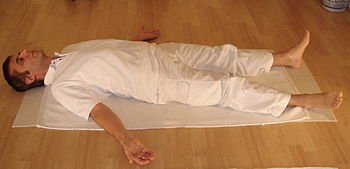
Another useful exercise is to have students (this works well with a class as a whole, if they're receptive) lie on the floor on their backs. Dim the lights if possible. They should be in a classic yoga savasana position (corpse pose - see the picture at the top), legs apart about shoulder width, arms slightly away from the body, palms up, chin just barely tucked towards the chest to ensure the back of the neck isn't tight. Starting at the feet, talk them through tightening each part of their body on an inhale, drawing it tighter and tighter, and then releasing on the exhale. How slow or fast you do this can be varied depending on how much time you have, and how relaxed the students are at the beginning, but in general at least a breath each for feet & lower legs, thighs & butt, back & abdomen, arms & hands, chest & shoulders, and head & face. Then let them breathe for a little bit, imagining tension flowing out of their body and into the floor.
Once they seem well and truly relaxed, there are a number of different things you can start doing. Even simply lying there observing the breath without interference is helpful (and meditative). My first voice teacher would have us blow all the air out, imagining air coming up all the way from our toes, and blowing it out to the last dregs, and then filling up again, just as full as we had been empty, until our lungs couldn't possibly hold any more (do this very slowly to avoid hyperventilation).
My favorite is to start concentrating on the exhale. When someone has trouble getting enough air the impulse is always to worry about the inhale, which makes sense - too little air, so try to get more. Unfortunately it's exactly the wrong way around. Inhalation is pretty automatic - provided there's room in the lungs. Most people run out of breath because they haven't emptied their lungs sufficiently to bring in enough fresh air to meet their needs. A student will hold their breath, feel oxygen deprived, and try to suck in more air without ever having truly exhaled what was already in there. The result is a lot of shallow gasping. Contrariwise, if they concentrate on blowing out, the body will automatically suck in fresh air once they're done - problem solved.
Within the context of the savasana exercise, I have people start thinking of the breath as starting with the exhale. Counting each breath, starting with "one" on the exhale, "and" on the inhale, "two" on the next exhale, etc. can get the point across. Have them put all the effort of the breath into the exhale, the inhale should float into their lungs with no effort on their part at all. (It does take a while for most people to achieve. Thinking of the breath as starting with the inhale, and putting the effort on the inhale is fairly universal, at least around here.)
In general about 5-15 minutes (total, including the initial tensing and relaxing) is a good length for this exercise. Too long and you may find that people have fallen asleep.
Effort on the exhale can also be programmed into kata practice. With students who have problems holding their breath when doing kata under stress (I.e. those who forget to breathe, rather than those with structural breathing problems), I'll help them look for places to build in exhalation to their kata. If certain techniques are always accompanied by a pronounced exhale, the inhale will follow behind automatically. Most times I find that building in the exhales through the whole kata is unnecessary, a few strategically placed exhales will prompt the student and act as a vaccine against holding the breath throughout.
Pronounced exhaling can also be a stress-management technique during performance. In my brown belt test video, one of the things I noticed was how audible my exhales were in almost all the katas. Not ideal perhaps, but distinctly better than either hyperventilating or forgetting to breathe. Likewise, a pronounced exhale followed by a deep inhale has a distinct relaxing effect on the muscles, which is useful before things like board breaks, when you need the starting relaxation to get the necessary speed and power.
Belly breathing, relaxation, and effort on the exhale so far. Next time I'll get into appropriate, supportive tension.
Subscribe to:
Posts (Atom)